| |
| CLICK HERE FOR INDEX PAGE |
| |
| SI UNITS and OHM's LAW |
| |
| V. Ryan © 2002 -
2009 |
| |
| PDF FILE - CLICK HERE FOR PRINTABLE WORKSHEET |
| |
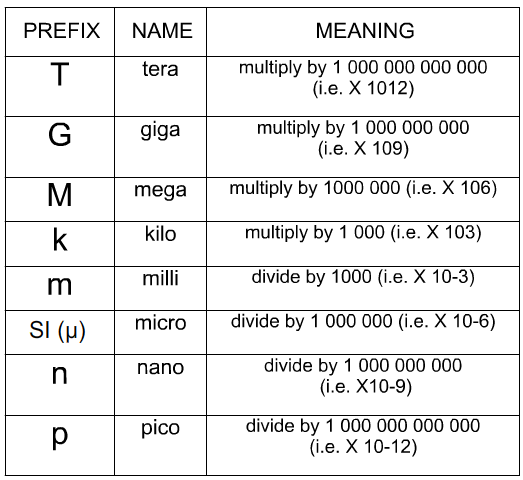
SI UNITS
The
system of units used in Technology and Science is the Systeme
Internationale d’unites (International system of units). Usually
abbreviated to SI units and is based on the metric system. This was
introduced in 1960 and is now adopted by the majority of countries as
the official system of measurement. The basic units in the SI system are listed in the table to the right with their symbols. |
| |
 |
| |
|
|
| |
| Ohm’s Law |
| Provides us with a very
important formula for working out current, resistance and voltage
(Potential Difference). In order to use this formula properly you must
understand SI Units. |
| |
| Voltage = V Resistance
= R Current = I |
| |
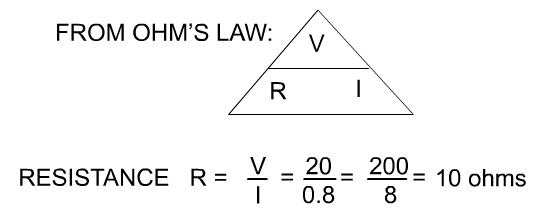
| Problem 1. If the current through a resistor is 0.8A and the voltage is 20v - what
is the resistance ? |
| |
 |
| |
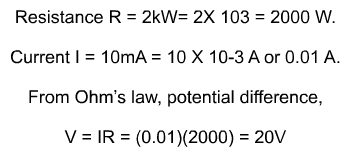
| Problem 2. Determine the p.d. (voltage) which must be applied to a 2kW resistor in
order that a current of 10mA may flow. |
| |
 |
| |
|
|
| |
| Problem 3.A coil
has a current of 50 mA flowing through it when the voltage is 12 V. What
is the resistance of the coil? |
| |
 |
| |
| Have a go at answering the following questions: |
| |
| Problem 4. A 100 V battery is connected across a resistor
and causes a current of 5mA to flow. Determine the resistance of the
resistor. If the voltage is reduced to 25 V, what will be the new value
of the current flowing? |
| |
| Problem 5.What
is the resistance of a coil which draws a current of (a) 50 mA and (b)
200mA from a 120 V supply. |
| |
| |
| What is an INSULATOR ? |
| |
An insulator is a material that does not allow
current to flow through it. Materials such as rubber and plastic are
good insulators and this is why they are used in the electrical industry
to insulate parts.
Consider electric drills. Why do they have a plastic case ? The plastic
insulates the person using the drill from all the electrical parts so
that they are protected from electrocution. |
| |
|
|
| |
| CLICK HERE ELECTRONICS INDEX PAGE |
| |
| |
| |